Dharisanam ENதமிழ்
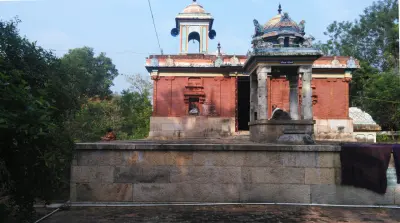
A red-walled temple with a small mandapam in front, standing on a raised stone platform among trees.
Swayambu

Vaikal Maadakkoil Sri Vaikalnatheswarar Temple 33rd of 129 on the south bank of the Kaveri · Chola Nadu · Temples near Mayiladuthurai

Darshan today7:00 am – 7:00 pm
Moolavar
Vaikalnatheswarar
Ambal
Vaikal Ambigai, Kombiyal Kothai
Theertham
Shenbaka Theertham
Sthala vriksham
Shenbaka Plant
Pathigam by
Thirugnanasambanthar-1

Temple

Visited on: December 16, 2017.

Location

Vaikal is situated at a distance of about 12 kms from Kumbakonam on the Kumbakonam to Karaikkal route. After crossing Thiruneelakkudi, S.Pudur and Pazhiyanchiya Nallur, take the diversion road and proceed further for about 2 kms to reach Vaikal.

Vaikal is about 4 kms from Thiruneelakkudi as well as Konerirajapuram (Nallam).

Other Devara Paadal Petra Shiva Sthalams near this place are - Thirunallam (Konerirajapuram), Thiru Kozhambiam, Thiruneelakkudi, Thenkurangadu Thurai (Aduthurai), Thiruvidaimaruthur and Thiruvavaduthurai.

General information

Moolavar
Sri Vaikalnatheswarar
Ambal
Sri Vaikal Ambigai, Sri Kombiyal Kothai
Theertham (Holy water)
Shenbaka Theertham
Sthala Vriksham (Sacred Tree)
Shenbaka Plant
Pathigam (Hymn) rendered by
Saint Thirugnanasambanthar-1
  • This is one of the 276 Devara Paadal Petra Shiva Sthalams and 33rd Shiva Sthalam on the Southern bank of the river Cauveri in Chozha Nadu (Thenkarai).
  • Lord Shiva in this temple is a Swayambumurthi (self-manifested).
  • This temple is counted as one of the Maadak Koils built by King Kochengat Cholan.
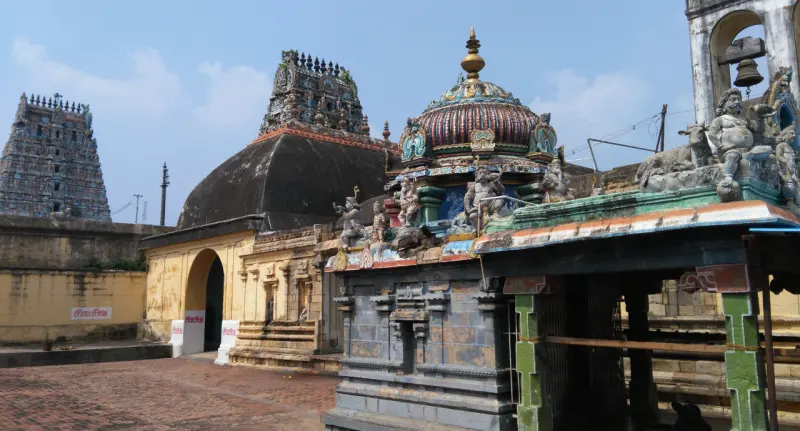
  • This east facing temple has a single corridor and its main tower does not have any tiers.

History of the temple

Vaikal is situated on the southern bank of the river Nattaru. This ancient temple is believed to have been constructed by the Cholas.

Once this place was a forest full of Shenbaga trees. Hence this place gets the name Shenbagaranyam and the lord is praised as Sri Shenbagaranyeswarar.

This place’s name “Vaikal” is derived from Vai-kuru-kal meaning a small hill in Tamil.

The historical names of this place are Shenbagaranyam, Mummoorthy Sthalam and Nithyavasapuram.

This temple is under the administrative control of the Hindu Religious and Charitable Endowments Department of Government of Tamil Nadu (HR&CE). This temple is under the supervision of Thirunageswaram temple EO.
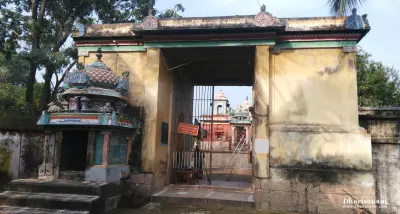
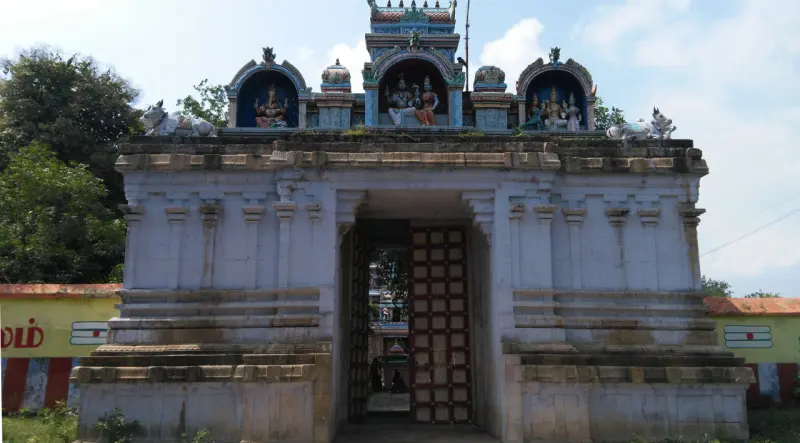
A yellow gateway with a small shrine on its left; the temple's red walls show through the open gate.

Legend

There are three Shiva temples in Vaikal – they are Vaikal Maadakkoyil, Sri Kasi Viswanathar Koil and Sri Brahmapureeswarar Koil. These three temples are considered to be representing the three eyes of Lord Shiva (“Mukkan Kshetram” or “muntru kan kshetram”). “Muntru” means three, “kan” means eye and “kshetram means temple in Tamil. All these three temples are located in a radius of one kilometre only. They are as follows -

Kasi Viswanathar Koil is considered to be the right eye of Lord Shiva. Lord Mahavishnu is believed to have worshiped Sri Kasi Viswanathar and Sri Visalakshi there.

Brahmapureeswarar Koil is considered to be the left eye. Lord Brahma is believed to have worshiped “Sri Brahmapureeswarar” and Sri Periya Nayaki there.

Sri Vaikalnathar temple is said to represent the eye on Lord Shiva’s forehead. Sri Kombiyal Kothai is the goddess here. Saint Thirugnanasambanthar rendered his pathigam in this temple. This temple is counted as one of the Maadak Koils built by King Kochengat Cholan.

The legend connecting these three temples involves Bhoomidevi (Bhoodevi). It is believed that she requested Lord Mahavishnu to marry her. The lord accepted her request and married her. Angered by his marriage, Lord Mahavishnu’s wife Thirumakal (Sridevi / Lakshmi) left Vishnu and came to this place. She meditated on Lord Shiva and performed rigorous penance. Vishnu and Bhoodevi also came here in search of Lakshmi and prayed to Lord Shiva.

Brahma also came to this place in search of Vishnu and worshiped Lord Shiva.

Lord Shiva advised Lakshmi to accept the marriage of Vishnu and Bhoodevi.

The Sthala Puranam of this temple states that when an elephant was searching for its calf, it inadvertently damaged an anthill. The ants bit the elephant and killed it. It is believed that both the calf and the ants prayed to Lord Shiva. The young elephant was consoled for its loss and the ants were pardoned for their sins.

Lord Vishnu, Goddess Lakshmi, Brahma, Indira, Suryan, Devas and Agasthiyar have worshiped the lord here.

Deities in the temple

At Sri Vaikalnathar temple

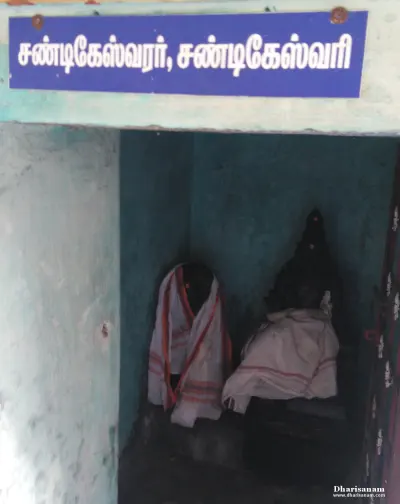
Sri Vaikalnathar Vinayakar, Sri Kombiyal Kothai, Vinayakar, Murugan with his consorts, Mahavishnu with Sridevi and Bhoodevi, Gajalakshmi, Chandikeswarar with Chandikeswari, Kalabairavar and Saneeswarar can be seen. There is no Navagraham here.
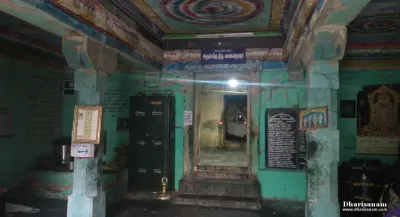
A green-walled hall with painted ceiling, a lit doorway ahead with steps, and a black notice board at right.
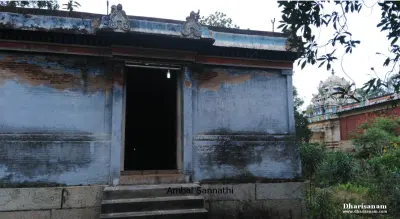
A small stone shrine with a flat roof and steps up to a dark doorway; Ambal Sannathi is written across the front.
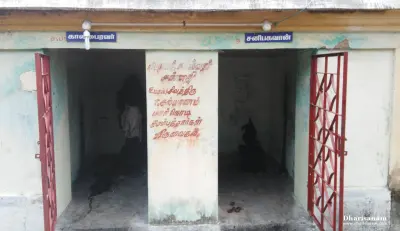
Two small shrines side by side with red gates, under blue name boards for Kalabairavar and Saneeswarar.
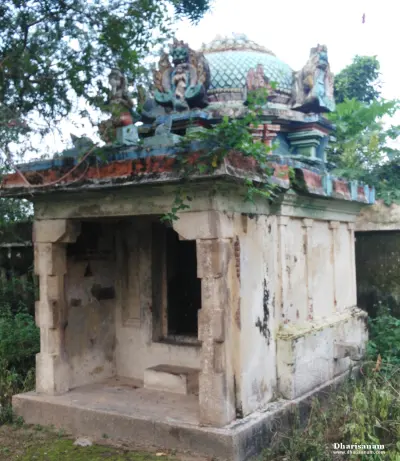
A small stone shrine with a painted dome and plaster figures on top, partly covered by creepers.
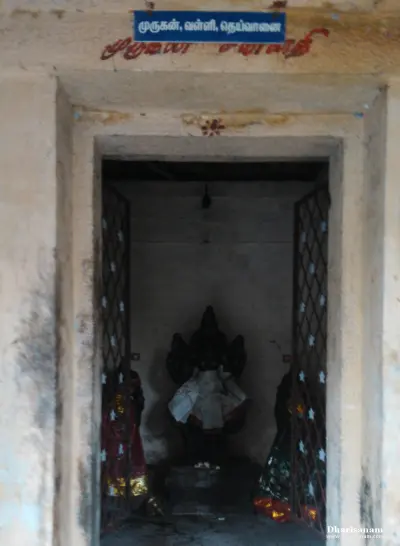
A dark idol with robed figures on either side, seen through iron gates; a blue board names Murugan, Valli and Deivanai.
A small shrine with a dark central idol and two robed figures at its sides; a blue board names Bhoodevi and Sridevi.
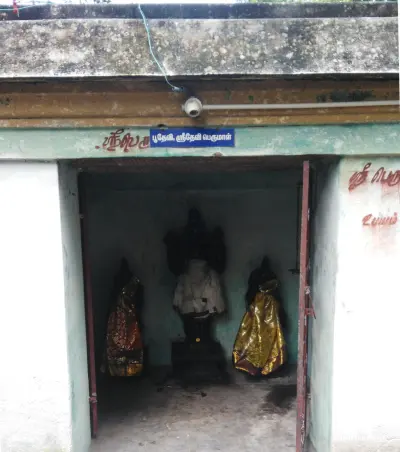
Two dark idols in white cloths in a green-walled niche, under a blue board naming Chandikeswarar and Chandikeswari.

At Sri Kasi Viswanathar temple

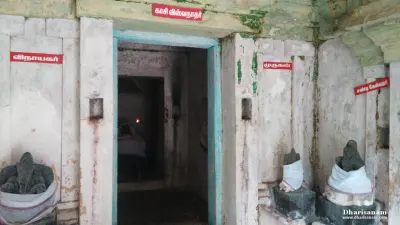
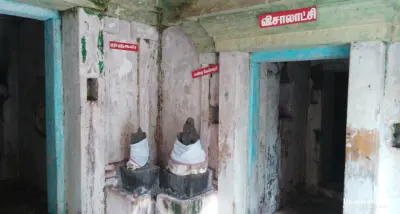
Sri Kasi Viswanathar, Sri Visalakshi, Vinayakar, Murugan, and Chandikeswarar only.

A doorway with red name boards for Kasi Viswanathar, Vinayakar, Murugan and Chandikeswarar; small idols on stone bases.
Two small idols in white cloths on stone bases, with red boards for Murugan and Chandikeswarar; a Visalakshi doorway.
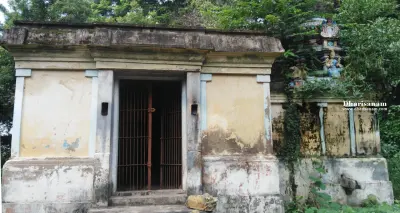
A small shrine with plain walls and a closed iron gate; a painted tower and figure show above the wall at right.

At Sri Brahmapureeswarar temple

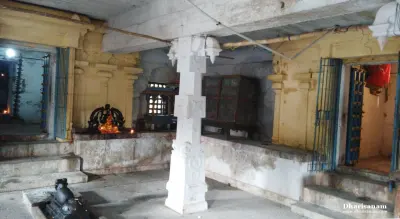
Sri Brahmapureeswarar, Sri Periya Nayaki, Vinayakar, Murugan with his consorts, Dakshinamurthy, Durgai, Bairavar, Suryan, Chandran, Nalvar, Gajalakshmi, Navagraham, Nandhi, Balipeet and flag post can be seen.

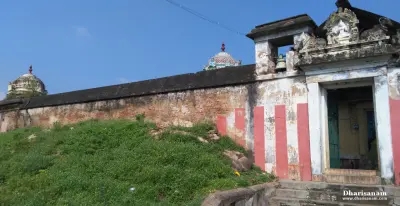
A long brick wall beside a grassy slope, with a gateway topped by a Ganesha figure at right and two domes beyond.
A covered stone corridor with a white pillar, a small Nandi at lower left, a lit lamp and shrine doorways on both sides.
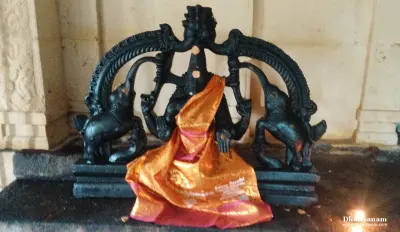
A black stone idol seated under an arch, with an elephant on each side and an orange silk cloth draped over it.

Salient features

It is believed that King Kochengat Chola built about 70 “Madakkoils”. The distinguishing feature of a Madakkoil is that it is not easily approachable by an elephant. He built these temples at an elevation and there are a few steps that need to be climbed before seeing the lord. Also, the sanctum sanctorum’s (Karpagragam) entrance is narrow such that no elephant can enter it.

In his Pathigam of this temple, Saint Thirugnanasambanthar mentioned that

whoever recites this Pathigam will reach Lord Shiva’s abode. Further, he mentioned that -

This temple is equivalent to Mount Kailash,

This temple was built by Kochengat Cholan,

This temple is on the western side of the village, and

He praised the Goddess as “Kombiyal Kothai”.

Greatness of this temple

Devotees believe that by worshiping the lord here, obstacles from their marriage proposals will be removed.

Devotees also believe that worshipping Lord Shiva here will bless them with wealth and prosperity. Further they believe that they can rid themselves of the fear of death. (fear of Lord Yama).

Important festivals

Some of the important festivals celebrated in the temple are –

Shivrathri in the Tamil month of Masi (Feb-Mar),

Navarathri in the Tamil month of Purattasi (Sept-Oct), and

Annabishekam in the Tamil month of Aippasi (Oct–Nov).

Temple timings

From 07.00 AM to 07.00 PM.

The caretaker of this temple stays nearby and can be contacted for darshan. The temple priest is said to be coming here only once a day for one hour.

Temple address

Sri Vaikal Nathar Temple,
Vaikal Village, Melaiyur Post,
Aduthurai Via,
Tanjure District,
Tamil Nadu – 612101.

Temple caretaker (Meikkaaval), Mr. Balakrishnan can be contacted at: +91 9788992860.

*
Open the map →
NavigateGet directions in Google Maps
Today7:00 am – 7:00 pm
Phone+91 9788992860
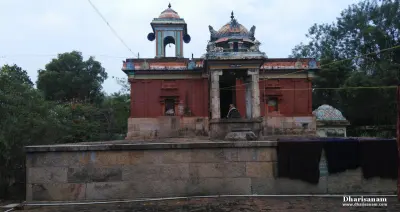
A red-walled temple with a small mandapam and a bell tower, behind a long stone wall and under tall trees.
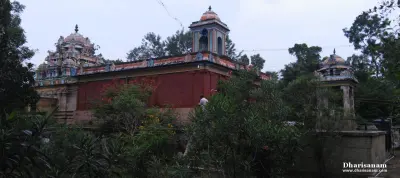
A long red wall with a painted roof edge and a bell tower, with a tower on the left and a small pavilion at right.
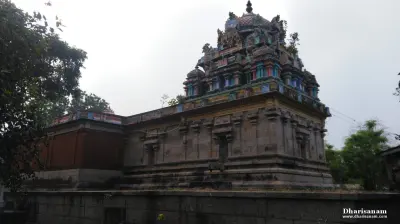
A stone-walled sanctum with a small painted tower, seen from the side beyond a low stone wall under a cloudy sky.

Highlights

What makes this temple special

* Cards drawn from the temple write-up and photographs. “Read more” takes you to the full passage.

Greatness

A Madakkoil and a temple like Mount Kailash

The temple is counted among the Madakkoils built by King Kochengat Cholan, and it is said to be equivalent to Mount Kailash.

  1. A MadakkoilA Madakkoil is not easily approachable by an elephant: it stands at an elevation, steps must be climbed, and the sanctum entrance is narrow.
  2. Equivalent to Mount KailashSaint Thirugnanasambanthar mentioned in his Pathigam that this temple is equivalent to Mount Kailash.
  3. Reciting the PathigamWhoever recites this Pathigam will reach Lord Shiva's abode.
  4. Three temples, three eyesThe three Shiva temples of Vaikal are considered to represent the three eyes of Lord Shiva.
Significance

A Devara Paadal Petra Shiva Sthalam

Saint Thirugnanasambanthar rendered his Pathigam in this temple, which is one of the Devara Paadal Petra Shiva Sthalams.

  1. One of the 276 Paadal Petra SthalamsThis is the 33rd Shiva Sthalam on the Southern bank of the river Cauveri in Chozha Nadu.
  2. Built by Kochengat CholanThis temple is counted as one of the Madakkoils built by King Kochengat Cholan.
  3. The eye on the foreheadThis temple is said to represent the eye on Lord Shiva's forehead.
  4. Worshipped by manyLord Vishnu, Goddess Lakshmi, Brahma, Indira, Suryan, Devas and Agasthiyar have worshiped the lord here.
Why devotees come

Why devotees come here

Devotees come with prayers about marriage, prosperity and the fear of death.

  1. For marriage: obstacles removedDevotees believe that by worshiping the lord here, obstacles from their marriage proposals will be removed.
  2. For wealth and prosperityDevotees also believe that worshipping Lord Shiva here will bless them with wealth and prosperity.
  3. For freedom from the fear of deathThey also believe that they can rid themselves of the fear of death (fear of Lord Yama).
Sri Vaikalnathar temple, raised above the ground
276Paadal Petra Sthalams

Among the Paadal Petra Sthalams

Legends of Vaikal

Angered by Vishnu's marriage to Bhoodevi, Lakshmi came here and meditated on Lord Shiva; Vishnu and Bhoodevi came in search of her and prayed to Lord Shiva.

Brahma also came to this place in search of Vishnu and worshiped Lord Shiva.

An elephant searching for its calf damaged an anthill and was killed by the ants; the calf and the ants prayed to Lord Shiva and were consoled and pardoned.

Festivals through the year

    Shivrathri in Masi, Navarathri in Purattasi and Annabishekam in Aippasi are celebrated here.

    Deities

    The deities of this temple

    * Drawn from the temple write-up and photographs. Where there is no photograph, the card shows the name.

    From the sanctum to the corridors
    Moolavarவை
    Moolavar

    Sri Vaikalnatheswarar

    Lord Shiva in this temple is a Swayambumurthi (self-manifested).

    A small stone shrine with a flat roof and steps up to a dark doorway; Ambal Sannathi is written across the front.
    Ambal

    Sri Kombiyal Kothai

    Sri Kombiyal Kothai is the goddess here. She is also known as Sri Vaikal Ambigai.

    A dark idol with robed figures on either side, seen through iron gates; a blue board names Murugan, Valli and Deivanai.
    Shrine at the Vaikalnathar temple

    Murugan with his consorts

    Murugan with his consorts can be seen at Sri Vaikalnathar temple.

    A small shrine with a dark central idol and two robed figures at its sides; a blue board names Bhoodevi and Sridevi.
    Shrine at the Vaikalnathar temple

    Mahavishnu with Sridevi and Bhoodevi

    Mahavishnu with Sridevi and Bhoodevi can be seen at Sri Vaikalnathar temple.

    Two dark idols in white cloths in a green-walled niche, under a blue board naming Chandikeswarar and Chandikeswari.
    Shrine at the Vaikalnathar temple

    Chandikeswarar with Chandikeswari

    Chandikeswarar with Chandikeswari can be seen at Sri Vaikalnathar temple.

    Two small shrines side by side with red gates, under blue name boards for Kalabairavar and Saneeswarar.
    Shrines at the Vaikalnathar temple

    Kalabairavar and Saneeswarar

    Kalabairavar and Saneeswarar can be seen. There is no Navagraham here.
    A doorway with red name boards for Kasi Viswanathar, Vinayakar, Murugan and Chandikeswarar; small idols on stone bases.
    Moolavar of the Kasi Viswanathar temple

    Sri Kasi Viswanathar

    Lord Mahavishnu is believed to have worshiped Sri Kasi Viswanathar and Sri Visalakshi there.

    A black stone idol seated under an arch, with an elephant on each side and an orange silk cloth draped over it.
    Shrine at the Brahmapureeswarar temple

    Gajalakshmi

    Sri Brahmapureeswarar, Sri Periya Nayaki, Gajalakshmi, Nandhi, Balipeet and flag post can be seen.
    Visit & map

    Sacred geography
    Vaikal Maadakkoil Thirukkozhambam Thiruneelakkudi Thiruvavaduthurai Vanniyur Karuvili Kottitai Thiruppananthal Thirucherai Thirumangalakkudi Thirukkodikkaval Thiruviyalur Thirunallam Sirukudi
    You are hereThis temple

    Schematic. Distances as recorded on the visit; directions approximate.

    12a6a12p6p
    Darshan today7:00 am – 7:00 pm
    7:00 – 7:00

    Hours as recorded on the visit. Festival days can differ.

    Plan the day around it

    Address and phone

    Sri Vaikal Nathar Temple, Vaikal Village, Melaiyur Post, Aduthurai Via, Tanjure District, Tamil Nadu – 612101. Temple caretaker (Meikkaaval), Mr. Balakrishnan can be contacted at: +91 9788992860.
    *

    A day of darshan nearby

    5 more sthalams within reach, nearest first: 14.3 km in straight lines.

    Map of Vaikal Maadakkoil and the sthalams nearby, in route order: Thirukkozhambam, Thiruvavaduthurai, Thirukkodikkaval, Thiruppananthal, Thirumangalakkudi. Thiruneelakkudi · 3.8 km Thiruviyalur · 7.4 km Vaikal Maadakkoil 1 Thirukkozhambam 2 Thiruvavaduthurai 3 Thirukkodikkaval 4 Thiruppananthal 5 2 km N
    Drawn from coordinates. Straight-line distances; roads are longer. Faint dots are other sthalams within 50 km.

    Temple plan

    A yellow gateway with a small shrine on its left; the temple's red walls show through the open gate.
    01

    Reaching Vaikal

    After crossing Thiruneelakkudi, S.Pudur and Pazhiyanchiya Nallur, take the diversion road and proceed further for about 2 kms to reach Vaikal.

    1 / 7

    Summary written with AI help from the temple write-up.

    Pathigam

    Saint Thirugnanasambanthar visited this temple and sang this Pathigam.

    Devotees visiting this temple should make it a practice to recite this Pathigam.

    V. Muthukumaraswamy

    Thirugnanasambandar visited this temple and sang this Pathigam. Verse 1 of 11.

    Thuḷamathi yuṭaimaṟi thōṉtṟu kaiyiṉar
    iḷamathi yaṇisaṭai enthai yāriṭam
    uḷamathi yuṭaiyavar vaika lōṅkiya
    vaḷamathi thaṭaviya māṭak kōyilē

    He holds a deer in his hand and wears the young crescent moon on his matted hair; he is our father. His abode, for those of discerning heart, is the lofty Madakkoil of Vaikal, which the full moon brushes.

    Tap any Tamil word for its meaning

    Verse text and transliteration as given in the write-up. Word meanings and the English meaning are AI-assisted drafts.

    All eleven verses

    1. 01

      துளமதி யுடைமறி தோன்று கையினர்இளமதி யணிசடை எந்தை யாரிடம்உளமதி யுடையவர் வைக லோங்கியவளமதி தடவிய மாடக் கோயிலே

      Thuḷamathi yuṭaimaṟi thōṉtṟu kaiyiṉar / iḷamathi yaṇisaṭai enthai yāriṭam / uḷamathi yuṭaiyavar vaika lōṅkiya / vaḷamathi thaṭaviya māṭak kōyilē

    2. 02

      மெய்யகம் மிளிரும்வெண் ணூலர் வேதியர்மையகண் மலைமக ளோடும் வைகிடம்வையகம் மகிழ்தர வைகல் மேற்றிசைச்செய்யகண் வளவன்முன் செய்த கோயிலே

      Meyyakam miḷirumveṇ ṇūlar vēthiyar / maiyakaṇ malaimaka ḷōṭum vaikiṭam / vaiyakam makizhthara vaikal mētṟisaich / cheyyakaṇ vaḷavaṉmuṉ seytha kōyilē

    3. 03

      கணியணி மலர்கொடு காலை மாலையும்பணியணி பவர்க்கருள் செய்த பான்மையர்தணியணி உமையொடு தாமுந் தங்கிடம்மணியணி கிளர்வைகல் மாடக் கோயிலே

      Kaṇiyaṇi malarkoṭu kālai mālaiyum / paṇiyaṇi pavarkkaruḷ seytha pāṉmaiyar / thaṇiyaṇi umaiyoṭu thāmun thaṅkiṭam / maṇiyaṇi kiḷarvaikal māṭak kōyilē

    4. 04

      கொம்பியல் கோதைமுன் அஞ்சக் குஞ்சரத்தும்பிய துரிசெய்த துங்கர் தங்கிடம்வம்பியல் சோலைசூழ் வைகல் மேற்றிசைச்செம்பியன் கோச்செங்க ணான்செய் கோயிலே

      Kompiyal kōthaimuṉ añchak kuñcharath / thumpiya thuriseytha thuṅkar thaṅkiṭam / vampiyal chōlaichūzh vaikal mētṟisaich / chempiyaṉ kōchcheṅka ṇāṉsey kōyilē

    5. 05

      விடம்அடை மிடற்றினர் வேத நாவினர்மடமொழி மலைமக ளோடும் வைகிடம்மடவனம் நடைபயில் வைகல் மாநகர்க்குடதிசை நிலவிய மாடக் கோயிலே

      Viṭamaṭai miṭatṟiṉar vētha nāviṉar / maṭamozhi malaimaka ḷōṭum vaikiṭam / maṭavaṉam naṭaipayil vaikal mānakark / kuṭathisai nilaviya māṭak kōyilē

    6. 06

      நிறைபுனல் பிறையொடு நிலவு நீள்சடைஇறையவ ருறைவிடம் இலங்கு மூவெரிமறையொடு வளர்வுசெய் வாணர் வைகலில்திறையுடை நிறைசெல்வன் செய்த கோயிலே

      Niṟaipuṉal piṟaiyoṭu nilavu nīḷsaṭai / iṟaiyava ruṟaiviṭam ilaṅku mūveri / maṟaiyoṭu vaḷarvusey vāṇar vaikalil / thiṟaiyuṭai niṟaiselvaṉ seytha kōyilē

    7. 07

      எரிசரம் வரிசிலை வளைய ஏவிமுன்திரிபுரம் எரிசெய்த செல்வர் சேர்விடம்வரிவளை யவர்பயில் வைகல் மேற்றிசைவருமுகி லணவிய மாடக் கோயிலே

      Erisaram varisilai vaḷaiya ēvimuṉ / thiripuram eriseytha selvar sērviṭam / varivaḷai yavarpayil vaikal mētṟisai / varumuki laṇaviya māṭak kōyilē

    8. 08

      மலையன இருபது தோளி னான்வலிதொலைவுசெய் தருள்செய்த சோதி யாரிடம்மலர்மலி பொழிலணி வைகல் வாழ்வர்கள்வலம்வரு மலையன மாடக் கோயிலே

      Malaiyaṉa irupathu thōḷi ṉāṉvali / tholaivusey tharuḷseytha chōthi yāriṭam / malarmali pozhilaṇi vaikal vāzhvarkaḷ / valamvaru malaiyaṉa māṭak kōyilē

    9. 09

      மாலவன் மலரவன் நேடி மால்கொளமாலெரி யாகிய வரதர் வைகிடம்மாலைகொ டணிமறை வாணர் வைகலில்மாலன மணியணி மாடக் கோயிலே

      Mālavaṉ malaravaṉ nēṭi mālkoḷa / māleri yākiya varathar vaikiṭam / mālaiko ṭaṇimaṟai vāṇar vaikalil / mālaṉa maṇiyaṇi māṭak kōyilē

    10. 10

      கடுவுடை வாயினர் கஞ்சி வாயினர்பிடகுரை பேணிலார் பேணு கோயிலாம்மடமுடை யவர்பயில் வைகல் மாநகர்வடமலை யனையநன் மாடக் கோயிலே

      Kaṭuvuṭai vāyiṉar kañchi vāyiṉar / piṭakurai pēṇilār pēṇu kōyilām / maṭamuṭai yavarpayil vaikal mānakar / vaṭamalai yaṉaiyanaṉ māṭak kōyilē

    11. 11

      மைந்தன திடம்வைகல் மாடக் கோயிலைச்சந்தமர் பொழிலணி சண்பை ஞானசம்பந்தன தமிழ்கெழு பாடல் பத்திவைசிந்தைசெய் பவர்சிவ லோகஞ் சேர்வரே

      The last verse names Thirugnanasambandar of Sanbai and says that those who meditate on these Tamil verses will reach the world of Shiva.

      Mainthaṉa thiṭamvaikal māṭak kōyilaich / chanthamar pozhilaṇi saṇpai gñāṉasam / banthaṉa tamizhkezhu pāṭal paththivai / chinthaisey pavarsiva lōkañ sērvarē

    Photos

    Photographs

    18 photographs, in the order they appear in the write-up. Captions are AI-assisted.

    A red-walled temple with a small mandapam in front, standing on a raised stone platform among trees.
    A yellow gateway with a small shrine on its left; the temple's red walls show through the open gate.
    A green-walled hall with painted ceiling, a lit doorway ahead with steps, and a black notice board at right.
    A small stone shrine with a flat roof and steps up to a dark doorway; Ambal Sannathi is written across the front.
    Two small shrines side by side with red gates, under blue name boards for Kalabairavar and Saneeswarar.
    A small stone shrine with a painted dome and plaster figures on top, partly covered by creepers.
    A dark idol with robed figures on either side, seen through iron gates; a blue board names Murugan, Valli and Deivanai.
    A small shrine with a dark central idol and two robed figures at its sides; a blue board names Bhoodevi and Sridevi.
    Two dark idols in white cloths in a green-walled niche, under a blue board naming Chandikeswarar and Chandikeswari.
    A doorway with red name boards for Kasi Viswanathar, Vinayakar, Murugan and Chandikeswarar; small idols on stone bases.
    Two small idols in white cloths on stone bases, with red boards for Murugan and Chandikeswarar; a Visalakshi doorway.
    A small shrine with plain walls and a closed iron gate; a painted tower and figure show above the wall at right.
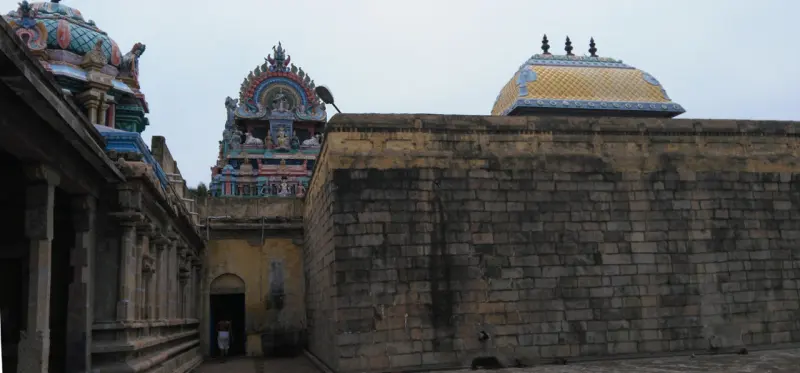
    A long brick wall beside a grassy slope, with a gateway topped by a Ganesha figure at right and two domes beyond.
    A covered stone corridor with a white pillar, a small Nandi at lower left, a lit lamp and shrine doorways on both sides.
    A black stone idol seated under an arch, with an elephant on each side and an orange silk cloth draped over it.
    A red-walled temple with a small mandapam and a bell tower, behind a long stone wall and under tall trees.
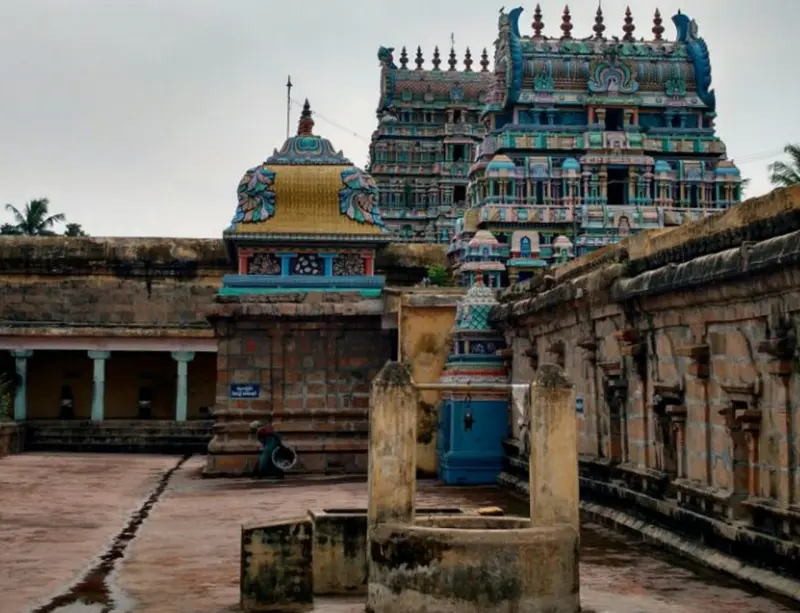
    A long red wall with a painted roof edge and a bell tower, with a tower on the left and a small pavilion at right.
    A stone-walled sanctum with a small painted tower, seen from the side beyond a low stone wall under a cloudy sky.